Changing Dynamics in Finance Operations
- EP: 2 Karmine Kompass , AI & The Future of Jobs | Usha Rangaraju
- EP : 1 Karmine Kompass , Future of Work, Powered by People | Shreyas Tonse, Zensible
- Agentic AI: A New Era for Finance Operations
- When Business Accounts Become Mules: The New Battlefield in Financial Fraud
- Digital Marketplace Scams: Follow the Money and Fight Back with AI
- EP: 2 Karmine Kompass , AI & The Future of Jobs | Usha Rangaraju
- EP : 1 Karmine Kompass , Future of Work, Powered by People | Shreyas Tonse, Zensible
- Agentic AI: A New Era for Finance Operations
- When Business Accounts Become Mules: The New Battlefield in Financial Fraud
- Digital Marketplace Scams: Follow the Money and Fight Back with AI
- EP: 2 Karmine Kompass , AI & The Future of Jobs | Usha Rangaraju
- EP : 1 Karmine Kompass , Future of Work, Powered by People | Shreyas Tonse, Zensible
- Agentic AI: A New Era for Finance Operations
- When Business Accounts Become Mules: The New Battlefield in Financial Fraud
- Digital Marketplace Scams: Follow the Money and Fight Back with AI
The world of finance operations is undergoing rapid transformation. Over the past decade, organizations have pursued greater efficiency, moving from manual processes to transactional Robotic Process Automation (RPA), and then to holistic hyper-automation. While each phase has delivered incremental gains, the next evolutionary leap is not merely about doing things faster but about doing things autonomously and intelligently.
Today, Agentic AI – autonomous AI “agents” that can perceive, reason, and act, is emerging as the next evolutionary step. Industry experts note that this transition to agentic AI is a natural progression in the automation journey, building on the foundations of machine learning, traditional AI models, and generative AI. In fact, agentic AI is touted as “the operating logic of tomorrow’s enterprise,” promising new levels of cost efficiency and growth for those who embrace it.
What is Agentic AI?
Agentic AI refers to intelligent systems designed to autonomously accomplish specific goals with limited human intervention. The difference becomes clear when comparing their operating models:
- Traditional Automation/RPA: Follows predefined rules or scripts; great for repetitive tasks but brittle when conditions change.
- Generative AI: Produces outputs (text, code, etc.) in response to prompts; powerful for content and analysis, yet it’s largely reactive.
- Agentic AI: Goes further by being proactive. It can set objectives, plan multi-step actions, make independent decisions, and adapt to new information. An agentic AI is less like a calculator and more like a junior colleague that can handle tasks end-to-end. Importantly, it operates on a goal and feedback loop rather than one prompt at a time
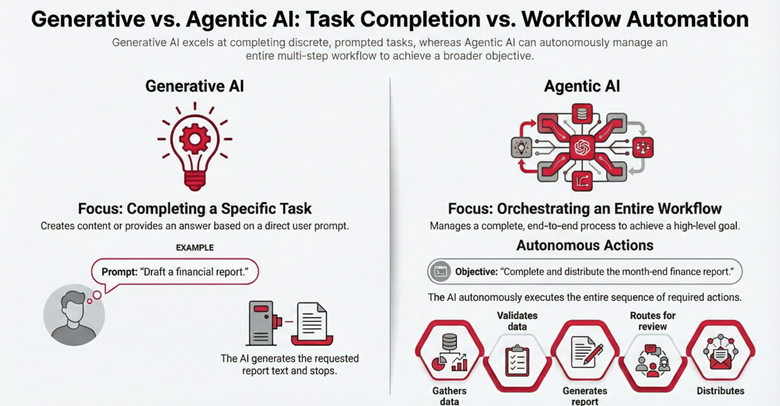
This ability to carry out multi-step processes and integrate with enterprise systems is a hallmark of agentic AI.
Key Attributes of Agentic AI – The Five Pillars
Agentic AI is defined by five core pillars that set it apart from traditional automation and earlier AI systems:
- Goal-driven: Agentic AI operates with clear objectives and continuously aligns its actions to achieve defined outcomes (e.g., reduce accounts payable cycle time), keeping the end goal central across all activities.
- Multi-step Planning & Orchestration: It can break complex objectives into sequenced actions, coordinate multiple tools (e.g., ERP, data warehouse, GenAI for analysis) or sub-agents, and execute end-to-end workflows through an iterative think-plan-act-evaluate-refine loop.
- Autonomous Decision-Making: Unlike static automation, the agent makes independent, context-aware decisions and manages exceptions dynamically without needing step-by-step human intervention, enabling true 24/7, near-continuous operations.
- Continuous Learning & Adaptation: Through feedback and learning mechanisms, agents models improve over time, adapting to new scenarios, regulatory changes, and process variations thus increasing accuracy and outperforming static rule-based automation.
- Transparency, Auditability & Trust: Built-in explainability, robust audit trails, and human oversight ensure decisions are traceable, compliant, and reviewable, upholding the highest standards of governance.
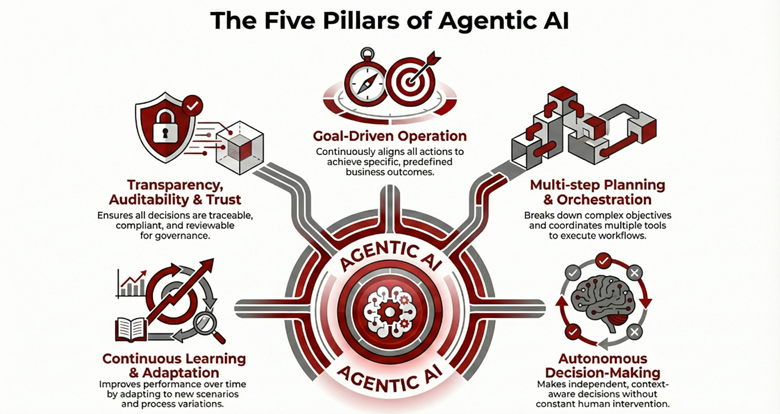
Together, these pillars allow agentic AI to function as a reliable, autonomous colleague in finance, capable of understanding context, executing complex processes, learning from outcomes, and operating transparently within defined guardrails.
Why Agentic AI in Finance?
The business case for Agentic AI in finance lies in its fit with the realities of modern financial operations – high data volumes, repetitive processes, time-critical decisions, and strict compliance requirements.
- End-to-end automation: Agents can potentially orchestrate entire finance processes, not just tasks, reducing handoffs and freeing teams for higher-value work.
- Faster decision-making: Real-time analysis and execution compress cycle times, enabling instant routine decisions and quicker insights for risk, treasury, and control functions.
- Improved accuracy and compliance: Reduced manual intervention lowers error rates, while consistent policy application and anomaly detection strengthen compliance and fraud detection.
- Scalable, 24/7 operations: Agents can operate continuously and scale seamlessly during peak periods without proportional increases in headcount
- Adaptive handling of complexity: Unlike rigid automation, Agents learn, manage exceptions, and adjust workflows as scenarios change. Of course, with sufficient ‘human-in-the-loop’ interventions.
In essence, Agentic AI allows finance teams to achieve more throughput and intelligence with less manual effort – cutting costs, improving resilience, and shifting human focus from routine execution to analysis, strategy, and value creation.
The Architecture: Moving Beyond Silos
In an agentic finance model, the CFO’s role expands from a sponsor to an architect. CFOs define the outcomes agents are accountable for, the risk boundaries they must respect, and the governance structures that ensure trust.
The true complexity and power of this era lie in the Agentic Architecture. It is not about deploying a single “super-bot,” but rather orchestrating a federation of specialized, coordinated agents that communicate seamlessly.
Consider the complexity of a global supply chain finance process. This might require:
- Handling invoice matching and payment initiation within the ERP.
- Optimizing cash flow and managing foreign exchange exposure based on payment timing.
- Continuously screening vendors and transactions against sanctions lists and internal policy.
These agents operate like a well-drilled team, sharing context and passing execution authority based on their specialized skills. This architectural shift enables organizations to break down functional silos, achieving true end-to-end process automation and optimization that traditional RPA could never manage.
Key Use Cases and Opportunities in Finance
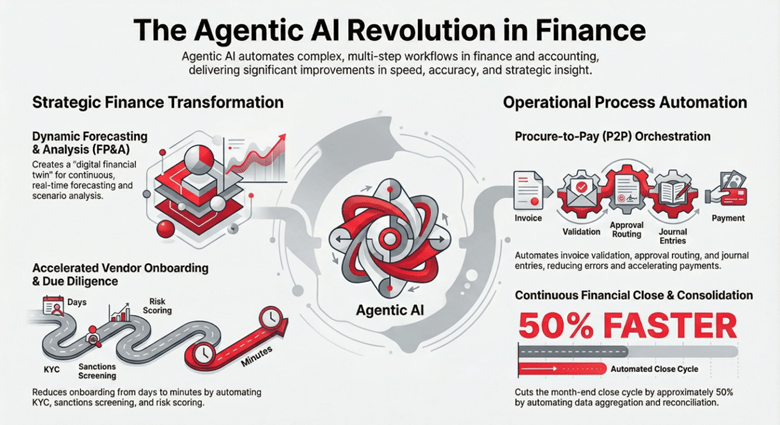
1.Dynamic Forecasting Planning & Analysis (FP&A): One of the most impactful areas is financial planning and analysis. Agentic AI can turn traditional periodic forecasting into a continuous, real-time activity. For example, AI agents can integrate data from ERP systems, market feeds, and spreadsheets to constantly update forecasts and run “what-if” scenarios. This creates a kind of digital financial twin that can simulates outcomes.
Agents can also provide nuanced analysis, spotting trends or anomalies in financial data that warrant attention. In essence, forecasting becomes more precise and proactive, with AI continuously recalibrating projections.
Impact: Forecasting becomes more precise, proactive, and directly actionable, dramatically improving resource allocation and capital efficiency.
2. Procure-to-Pay (P2P) Orchestration: AI agents can streamline invoice handling, for example, by automatically pulling data from incoming invoices, cross-validating it against purchase orders and goods receipts, and flagging any discrepancies. Tedious tasks like invoice coding, approval routing, and journal entries can be handled start-to-finish by an agent.
Impact: Lower error rates, accelerated payment cycles, and a shift of A/P staff from data entry to exception resolution.
3. Accelerated Vendor onboarding & Due Diligence: Multi-agent workflows can accelerate KYC/KYB, sanctions screening, and risk scoring, reducing onboarding from days to minutes while enabling continuous monitoring and robust audit trails. Imagine a team of AI agents working together: one agent gathers the vendor’s public data and documents, another cross-checks them against databases (for sanctions, politically exposed persons, adverse media), and a third evaluates the risk level or compliance requirements, all with no human handoffs in between.
By handling the grunt work of due diligence and doing it thoroughly and consistently Agents can help onboard vendors faster while enhancing compliance. Compliance officers can then focus on the truly suspicious cases rather than sifting through false positives.
Impact: Onboarding timelines reduced from days to minutes, robust and continuous monitoring, and allowing compliance officers to focus solely on high-risk, ambiguous cases.
4. Continuous Financial close & consolidation: The accounting close process (monthly, quarterly, annually) involves aggregating data from various systems, reconciling accounts, and preparing consolidated financial statements. It’s typically a labor-intensive crunch. In one case, a manufacturing company deployed an AI agent to manage its month-end close. The agent autonomously gathered trial balances from multiple ERPs, applied matching rules to reconcile entries, and even proposed adjusting journal entries for the finance team to review. It ultimately cut the close cycle by roughly 50%.
This example highlights how an agent can take over repetitive close tasks and execute them faster and more accurately. Additionally, because the agent works continuously, it enables a continuous close environment.
Impact: Organizations have adopted an Agentic AI solution to manage their month-end close, cutting the cycle time by approximately 50% and freeing up accounting staff for variance analysis.
Conclusion: Embracing the Agentic Future
Agentic AI marks a fundamental, irreversible shift, transforming finance from an operations utility into an agile, strategic growth engine. Early adopters are already seeing material gains, including faster closes, meaningful cost reductions, and improved accuracy, while freeing finance teams to focus on strategy, analysis, and innovation rather than execution.
Adoption, however, is not plug-and-play. It requires strong governance, transparency, ethical guardrails, and deliberate change management to ensure trust, control, and human oversight remain intact. When these foundations are in place, the operational and strategic upside far outweighs the risks.
Looking ahead, finance functions will not simply become faster or more efficient, they will become decisively intelligent and increasingly autonomous. Agentic AI marks the inflection point where finance shifts from executing processes to continuously steering outcomes, operating with speed, precision, and foresight that traditional models cannot match.
Organizations that invest early and responsibly will secure enduring advantages in cost efficiency, resilience, and decision quality transforming finance from a transactional back office into a strategic, always-on growth engine. The era of autonomous finance is no longer theoretical; it is already taking shape. Those who embrace it with strong governance, clear intent, and human judgment at the core will not only lead the transition, but help set the standards by which the future of finance will be defined.