Tag: Reg Tech

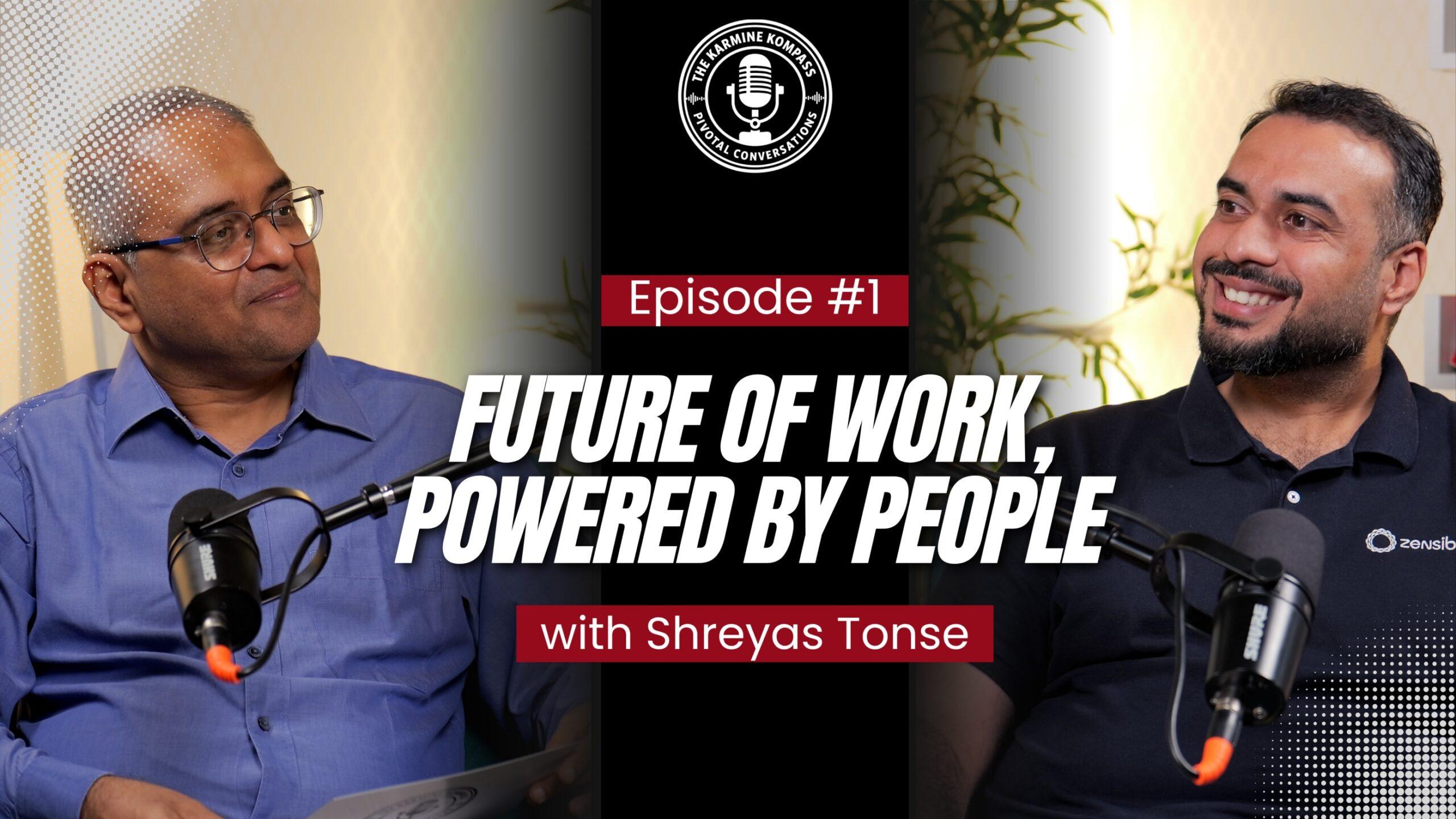
  • EP : 1 Karmine Kompass , Future of Work, Powered by People | Shreyas Tonse, Zensible

    EP : 1 Karmine Kompass , Future of Work, Powered by People | Shreyas Tonse, Zensible

    Welcome to the inaugural episode of Karmine Kompass: Pivotal Conversations!

    We kick off our journey to excellence with Shreyas Tonse of Zensible, the world’s first Total Experience (Tx) company in HR technology. This conversation is your roadmap to understanding the strategic shift needed to succeed in the digital-first era.

    We dive deep into why enterprises need to stop viewing HR software as fragmented tools and start treating it as a unified, strategic ecosystem that maximizes business value and employee experience.

    Connect with Shreyas Tonse & Zensible:

    About Karmine Consulting:

    Karmine Consulting is dedicated to guiding leaders through pivotal conversations. Subscribe for weekly insights that inspire, ignite, and align your business strategy.

    #KarmineKompass #ShreyasTonse #Zensible #HRTech #TotalExperience #LeadershipPodcast #BusinessStrategy #KarmineConsulting #AIinHR #FutureOfWork

  • Agentic AI: A New Era for Finance Operations

    Agentic AI: A New Era for Finance Operations

    Changing Dynamics in Finance Operations

    The world of finance operations is undergoing rapid transformation. Over the past decade, organizations have pursued greater efficiency, moving from manual processes to transactional Robotic Process Automation (RPA), and then to holistic hyper-automation. While each phase has delivered incremental gains, the next evolutionary leap is not merely about doing things faster but about doing things autonomously and intelligently.

    Today, Agentic AI – autonomous AI “agents” that can perceive, reason, and act, is emerging as the next evolutionary step. Industry experts note that this transition to agentic AI is a natural progression in the automation journey, building on the foundations of machine learning, traditional AI models, and generative AI. In fact, agentic AI is touted as “the operating logic of tomorrow’s enterprise,” promising new levels of cost efficiency and growth for those who embrace it.

    What is Agentic AI?

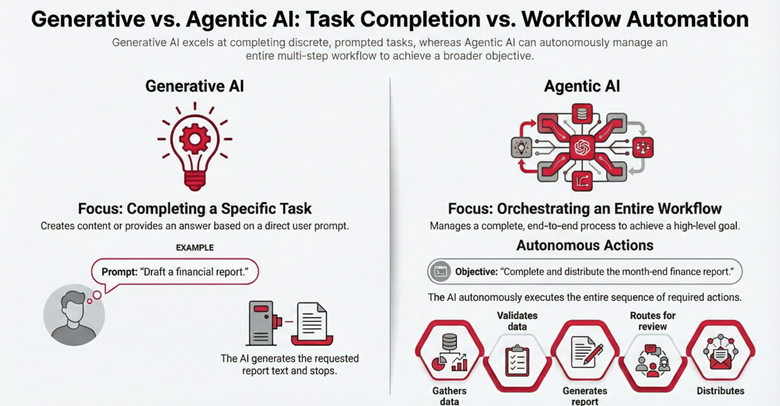
    Agentic AI refers to intelligent systems designed to autonomously accomplish specific goals with limited human intervention. The difference becomes clear when comparing their operating models:

    • Traditional Automation/RPA: Follows predefined rules or scripts; great for repetitive tasks but brittle when conditions change.
    • Generative AI: Produces outputs (text, code, etc.) in response to prompts; powerful for content and analysis, yet it’s largely reactive.
    • Agentic AI: Goes further by being proactive. It can set objectives, plan multi-step actions, make independent decisions, and adapt to new information. An agentic AI is less like a calculator and more like a junior colleague that can handle tasks end-to-end. Importantly, it operates on a goal and feedback loop rather than one prompt at a time

    This ability to carry out multi-step processes and integrate with enterprise systems is a hallmark of agentic AI.

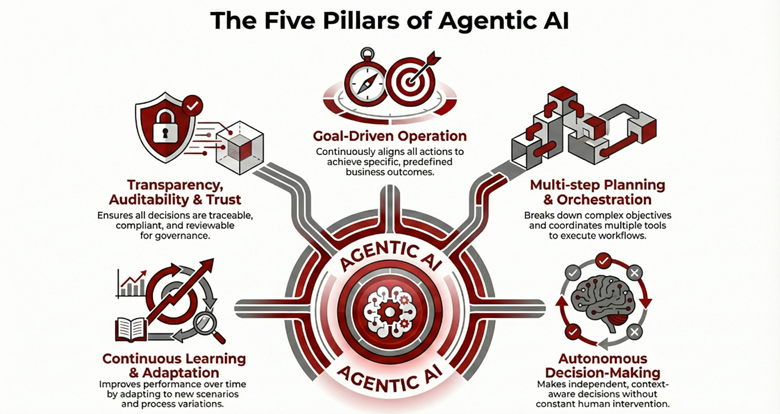
    Key Attributes of Agentic AI – The Five Pillars

    Agentic AI is defined by five core pillars that set it apart from traditional automation and earlier AI systems:

    • Goal-driven: Agentic AI operates with clear objectives and continuously aligns its actions to achieve defined outcomes (e.g., reduce accounts payable cycle time), keeping the end goal central across all activities.
    • Multi-step Planning & Orchestration: It can break complex objectives into sequenced actions, coordinate multiple tools (e.g., ERP, data warehouse, GenAI for analysis) or sub-agents, and execute end-to-end workflows through an iterative think-plan-act-evaluate-refine loop.
    • Autonomous Decision-Making: Unlike static automation, the agent makes independent, context-aware decisions and manages exceptions dynamically without needing step-by-step human intervention, enabling true 24/7, near-continuous operations.
    • Continuous Learning & Adaptation: Through feedback and learning mechanisms, agents models improve over time, adapting to new scenarios, regulatory changes, and process variations thus increasing accuracy and outperforming static rule-based automation.
    • Transparency, Auditability & Trust: Built-in explainability, robust audit trails, and human oversight ensure decisions are traceable, compliant, and reviewable, upholding the highest standards of governance.

    Together, these pillars allow agentic AI to function as a reliable, autonomous colleague in finance, capable of understanding context, executing complex processes, learning from outcomes, and operating transparently within defined guardrails.

    Why Agentic AI in Finance?

    The business case for Agentic AI in finance lies in its fit with the realities of modern financial operations – high data volumes, repetitive processes, time-critical decisions, and strict compliance requirements.

    • End-to-end automation: Agents can potentially orchestrate entire finance processes, not just tasks, reducing handoffs and freeing teams for higher-value work.
    • Faster decision-making: Real-time analysis and execution compress cycle times, enabling instant routine decisions and quicker insights for risk, treasury, and control functions.
    • Improved accuracy and compliance: Reduced manual intervention lowers error rates, while consistent policy application and anomaly detection strengthen compliance and fraud detection.
    • Scalable, 24/7 operations: Agents can operate continuously and scale seamlessly during peak periods without proportional increases in headcount
    • Adaptive handling of complexity: Unlike rigid automation, Agents learn, manage exceptions, and adjust workflows as scenarios change. Of course, with sufficient ‘human-in-the-loop’ interventions.

    In essence, Agentic AI allows finance teams to achieve more throughput and intelligence with less manual effort – cutting costs, improving resilience, and shifting human focus from routine execution to analysis, strategy, and value creation.

    The Architecture: Moving Beyond Silos

    In an agentic finance model, the CFO’s role expands from a sponsor to an architect. CFOs define the outcomes agents are accountable for, the risk boundaries they must respect, and the governance structures that ensure trust.

    The true complexity and power of this era lie in the Agentic Architecture. It is not about deploying a single “super-bot,” but rather orchestrating a federation of specialized, coordinated agents that communicate seamlessly.

    Consider the complexity of a global supply chain finance process. This might require:

    • Handling invoice matching and payment initiation within the ERP.
    • Optimizing cash flow and managing foreign exchange exposure based on payment timing.
    • Continuously screening vendors and transactions against sanctions lists and internal policy.

    These agents operate like a well-drilled team, sharing context and passing execution authority based on their specialized skills. This architectural shift enables organizations to break down functional silos, achieving true end-to-end process automation and optimization that traditional RPA could never manage.

    Key Use Cases and Opportunities in Finance

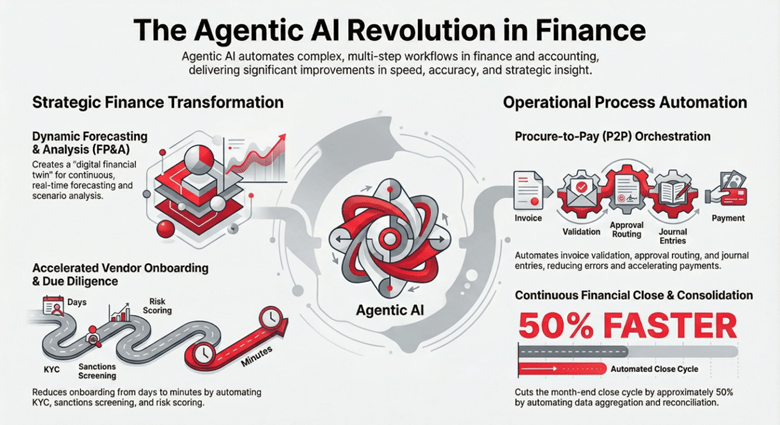
    1.Dynamic Forecasting Planning & Analysis (FP&A): One of the most impactful areas is financial planning and analysis. Agentic AI can turn traditional periodic forecasting into a continuous, real-time activity. For example, AI agents can integrate data from ERP systems, market feeds, and spreadsheets to constantly update forecasts and run “what-if” scenarios. This creates a kind of digital financial twin that can simulates outcomes.

    Agents can also provide nuanced analysis, spotting trends or anomalies in financial data that warrant attention. In essence, forecasting becomes more precise and proactive, with AI continuously recalibrating projections.

    Impact: Forecasting becomes more precise, proactive, and directly actionable, dramatically improving resource allocation and capital efficiency.

    2. Procure-to-Pay (P2P) Orchestration: AI agents can streamline invoice handling, for example, by automatically pulling data from incoming invoices, cross-validating it against purchase orders and goods receipts, and flagging any discrepancies. Tedious tasks like invoice coding, approval routing, and journal entries can be handled start-to-finish by an agent.

    Impact: Lower error rates, accelerated payment cycles, and a shift of A/P staff from data entry to exception resolution.

    3. Accelerated Vendor onboarding & Due Diligence: Multi-agent workflows can accelerate KYC/KYB, sanctions screening, and risk scoring, reducing onboarding from days to minutes while enabling continuous monitoring and robust audit trails. Imagine a team of AI agents working together: one agent gathers the vendor’s public data and documents, another cross-checks them against databases (for sanctions, politically exposed persons, adverse media), and a third evaluates the risk level or compliance requirements, all with no human handoffs in between.

    By handling the grunt work of due diligence and doing it thoroughly and consistently Agents can help onboard vendors faster while enhancing compliance. Compliance officers can then focus on the truly suspicious cases rather than sifting through false positives.

    Impact: Onboarding timelines reduced from days to minutes, robust and continuous monitoring, and allowing compliance officers to focus solely on high-risk, ambiguous cases.

    4. Continuous Financial close & consolidation: The accounting close process (monthly, quarterly, annually) involves aggregating data from various systems, reconciling accounts, and preparing consolidated financial statements. It’s typically a labor-intensive crunch. In one case, a manufacturing company deployed an AI agent to manage its month-end close. The agent autonomously gathered trial balances from multiple ERPs, applied matching rules to reconcile entries, and even proposed adjusting journal entries for the finance team to review. It ultimately cut the close cycle by roughly 50%.

    This example highlights how an agent can take over repetitive close tasks and execute them faster and more accurately. Additionally, because the agent works continuously, it enables a continuous close environment.

    Impact: Organizations have adopted an Agentic AI solution to manage their month-end close, cutting the cycle time by approximately 50% and freeing up accounting staff for variance analysis.

    Conclusion: Embracing the Agentic Future

    Agentic AI marks a fundamental, irreversible shift, transforming finance from an operations utility into an agile, strategic growth engine. Early adopters are already seeing material gains, including faster closes, meaningful cost reductions, and improved accuracy, while freeing finance teams to focus on strategy, analysis, and innovation rather than execution.

    Adoption, however, is not plug-and-play. It requires strong governance, transparency, ethical guardrails, and deliberate change management to ensure trust, control, and human oversight remain intact. When these foundations are in place, the operational and strategic upside far outweighs the risks.

    Looking ahead, finance functions will not simply become faster or more efficient, they will become decisively intelligent and increasingly autonomous. Agentic AI marks the inflection point where finance shifts from executing processes to continuously steering outcomes, operating with speed, precision, and foresight that traditional models cannot match.

    Organizations that invest early and responsibly will secure enduring advantages in cost efficiency, resilience, and decision quality transforming finance from a transactional back office into a strategic, always-on growth engine. The era of autonomous finance is no longer theoretical; it is already taking shape. Those who embrace it with strong governance, clear intent, and human judgment at the core will not only lead the transition, but help set the standards by which the future of finance will be defined.

  • When Business Accounts Become Mules: The New Battlefield in Financial Fraud

    When Business Accounts Become Mules: The New Battlefield in Financial Fraud

    For some time now, the “money mule” typologies have largely involved vulnerable individuals who were persuaded or coerced into moving illicit funds. Today, that typology is shifting into exploiting legitimate business current accounts, especially those belonging to MSMEs, to layer and route illicit funds at scale. This evolution is not just tactical; rather, it represents a well thought out reconfiguration of how criminal networks exploit the trust fabric underpinning the financial system.

    Recent cases reported across Indian banks highlight how MSME accounts are being hijacked, rented, or compromised to facilitate fast-moving, high-velocity transfers. This trend is accelerating, and financial institutions must re-evaluate their fraud detection and prevention strategies before systemic trust erodes any further.


    Business Accounts – New Mule Infrastructure

    1. Higher Transaction Thresholds

    Business current accounts routinely handle large-value transactions. A ₹3-5 lakh credit in an MSME account appears routine, whereas the same amount would seem anomalous in a retail account. This gives fraudsters a degree of anonymity through normalcy.

    2. Legitimacy and Established History

    Contrary to newly opened personal bank accounts, corporate entities generally come with a certain level of banking history, GST filings, payroll patterns, and vendor relationships. This legitimacy provides the necessary camouflage for fraudsters to move funds through current accounts.

    Often attributed as “Rent-a-Current-Account” model, struggling businesses, especially those with credit stress, rent their accounts for commissions where funds are layered through vendors, wallets, and forex channels before exiting the system.

    3. Lower Behavioural Predictability

    MSME activities differ dramatically across sectors based on their seasonality, client mixes, and growth cycles. This diversity makes it difficult for traditional transaction monitoring systems to establish a baseline for what “good” account behavior looks like.

    4. Insider or Peripheral Collusion

    Fraudsters capitalize on dormant partners, distressed business owners, accountants, or even compromised vendor relationships. In other cases, attackers gain access through identity compromise, or invoice-manipulation attacks.

    Criminal networks now favor “fewer, high-trust mule accounts” over a network of small retail mules, allowing them to transfer larger volumes with reduced exposure.

    5. Account Takeover via Business Email Compromise

    Cybercriminals compromise corporate email systems, intercept invoices, alter payment instructions, and quietly redirect funds into compromised or rented business accounts.

    6. Shell Firms Masquerading as Genuine MSMEs

    Criminals create fully documented shell companies, complete with incorporation proofs, basic trade activity, and GST registrations, to simulate legitimacy while acting as laundering pipelines.

    The common thread across all three is the exploitation of blind spots within traditional bank surveillance and due diligence procedures.


    Why Traditional Controls Fail

    1. Static KYC cannot keep up with dynamic risk

    KYC establishes identity at the time of onboarding or during periodic refresh, but businesses often evolve faster than the KYC cycle, sometimes into riskier entities. Without dynamic risk-refresh mechanisms or perpetual KYC procedures, banks remain blind to behavioural drift.

    2. Typical transaction monitoring typologies not designed for MSME complexity

    Rule-based transaction monitoring engines falter with MSMEs whose cash flows are non-linear, seasonal, and shaped by sector dynamics. As a result, generic rules either flood systems with false positives or miss detecting targeted mule activity.

    3. Lack of entity-resolution across accounts & identities

    A business is not a single account, rather it is an ecosystem of promoters, directors, accountants, devices, IPs, and counterparties. Legacy systems struggle to connect these signals and form a unified risk picture, analyzing each data point in isolation which creates blind spots that delay detection and prevents banks from recognizing coordinated or evolving threats across the wider business ecosystem.

    4. Limited Visibility Beyond the Bank’s Perimeter

    Fraud patterns often spread across institutions, but without consortium-level intelligence or federated learning programs, these signals stay under the radar. Fraudsters take advantage of this fragmentation, moving quickly between institutions to stay ahead of detection.


    Building Models that work – Our Perspective

    The surge in business-account mule activity highlights a crucial industry lesson: fraud cannot be solved through transaction monitoring alone. Detecting mule behavior, particularly in corporate accounts, requires multi-dimensional intelligence that connects digital signals, human context, and behavioural narratives.

    Karmine’s perspective centers on four essential pillars.

    1. Customer 360° : Moving Beyond Fragmented Risk Views

    A robust Customer 360° framework brings together identity, device, and behavioural signals across both retail and corporate profiles and integrates fraud and AML so that indicators such as account-takeover attempts or suspicious logins strengthen AML risk scoring. It also incorporates network-level intelligence to reveal links to shell firms, risky beneficiaries, or high-velocity counterparty rings.

    Traditional systems often treat fraud and AML as separate domains, even though mule activity sits directly at their intersection. A single, entity-level view can uncover risk patterns that often get missed in siloed systems.

    Only when a bank views the business as a single, holistic entity, rather than as a collection of accounts, can mule activity be detected in time.

    2. Early Risk Signals Appear Long Before Transactions Do

    Documentation inconsistencies, KYB anomalies, and behavioural red flags often emerge months before any transactional anomalies surface. These early signals provide valuable insight into whether a business is stable, legitimate, and operating as declared.

    Examples include mismatches between the stated nature of business and actual financial flows, templated or recycled incorporation documents, unexplained changes in ownership or authorized signatories, and income lines or operational footprints that do not match the speed of fund inflows. These indicators often hold predictive value and can highlight elevated risk before money movement becomes suspicious.

    To use this intelligence effectively, banks must integrate these non-transactional signals into their ongoing monitoring processes. When onboarding and KYB data is treated as one-time paperwork instead of continuous risk input, institutions lose early warning capabilities that can prevent misuse long before transactional behavior deteriorates.

    3. Relationship Managers – crucial interpreters of customer behavior

    For corporate and MSME segments, Relationship Managers (RMs) are a primary source of contextual understanding. They know their clients’ operational realities, seasonality, and market cycles, yet in most banks the RM layer remains disconnected from fraud and AML signals.

    To be effective, RMs need the ability to spot deviations between expected business behavior and actual transaction flows, escalate sudden shifts in volume, beneficiaries, or geographies, and validate whether a company’s banking behavior aligns with the patterns observed. Digital intelligence can detect anomalies, but only human context can explain them.

    4. Strong, Continuous KYC/KYB – A Non-Negotiable

    The shift from a legitimate business to a mule entity is often gradual, which makes static KYC frameworks insufficient on their own. A more continuous, risk-based KYB approach is needed, where updates are prompted by behavioural changes rather than waiting for a scheduled refresh.

    In practice, this means keeping an eye on sector-specific cash-flow patterns, checking whether the business model still appears viable, and periodically validating key details such as income sources, counterparties, staffing, and day-to-day operations. Simple, contextual risk scoring can help highlight when a business begins to deviate from its usual activity. In this model, understanding how a business operates becomes just as important as confirming who owns it.


    How Karmine Consulting can help

    For banks dealing with MSME portfolios, the real challenge is not just detecting mule accounts but understanding where and why the current system is blind. As a boutique AFC consulting firm, we aid institutions across some of their core considerations:

    • Governance & Risk Profile: Build a sharper, enterprise-level view of their MSME mule risk profile by identifying which sectors, clusters, ownership patterns, and transaction behaviors create the highest exposure.
    • Data: We aid in mapping data landscape end-to-end, assessing where relevant signals sit across KYC, GST data, account behaviors, trade documents, RM logs and counterparty flows and how much of this can be orchestrated to strengthen detection without waiting for multi-year modernization.
    • Process: We help refine processes for faster identification and cleaner reporting, redesign accountability structures across the three lines of defense, and define the RM/analyst skill sets needed to distinguish legitimate MSME churn from mule activity.
    • Tech: Finally, we help banks pinpoint the exact tech investments that will move the needle across entity resolution, network-graph analytics, document forensics, or continuous-KYC triggers.

    Through our interventions, we help ensure institutions build a scalable, intelligence-led MSME mule-detection capability rather than repurposing retail-focused controls
  • Less Noise, More Focus: How FinCEN is quietly rewiring the AML narrative

    Less Noise, More Focus: How FinCEN is quietly rewiring the AML narrative

    Introduction

    Recently, FinCEN released two developments that deserve close attention: the October 2025 SAR FAQs and a proposed Cost of Compliance Survey for NBFIs. Read together, these signals point to a shift away from measuring AML effectiveness through volume and accelerating toward evaluating quality and intelligence value of what is submitted.

    This is a significant reframing. The intent is not to reduce vigilance, but to challenge the long-standing assumption that more SARs automatically reflects stronger control and more spend implies deeper compliance entrenchment.

    The question is whether this shift will give institutions enough regulatory confidence to reduce defensive filing and instead base filing decisions on contextual suspicion and risk evidence.

    What the SAR FAQs clarify

    FinCEN is drawing a subtle boundary between suspicious behaviour and alert thresholds. The FAQ clarifies that –

    • Transactions near the US $10,000 currency threshold do not, by themselves, automatically require a SAR. A reason to suspect or suspicion remains the key trigger.
    • A separate account review is not obligatory post-SAR, unless the institution’s risk analysis supports it.
    • Institutions are not mandated to document every decision not to file a SAR, beyond alignment with risk-based internal controls.

    This is a direct encouragement to reduce mechanical alerting / reporting without weakening coverage integrity and move towards intelligence driven filings.

    The Proposed Compliance Cost Survey

    FinCEN has proposed a Cost of Compliance Survey and is seeking comments before implementation. This survey indicates their intent to build evidence before recalibrating the compliance burden. The survey targets casinos, money services businesses (MSBs), dealers in precious metals and stones, credit card operators and loan and finance companies because these segments carry high regulatory overhead but often may not produce proportional intelligence value.

    Structural changes cannot be justified based on industry sentiment or fatigue but require proof that the current architecture is not positioned to generate intelligence.

    This survey is aiming to distinguish where compliance effort translates into useful insight for enforcement versus where it simply creates operational volume.

    • Which activities generate genuine investigative value?
    • Which activities have high workload with low-intelligence outcomes?

    Shift in Regulatory Posture

    Read together with the SAR FAQs, this indicates a meaningful shift in supervisory posture.

    • From quantity to quality: Active dissuasion of reflexive filings triggered solely by thresholds or as simply a defensive practice. The directive seeks to question whether the cost of monitoring & filing is justified by results. Reduction in SAR output will only work if the coverage is not compromised.
    • From burden to calibration: The Survey acknowledges that AML/CFT compliance imposes real costs and that regulatory design should reflect proportionality.
    • From checklist to intelligence: The emphasis is shifting toward genuine risk-based programs driven by intelligent monitoring and meaningful results rather than sheer volume. This means that firms will have to implement stronger and comprehensive controls to defend their non-filing decisions.

    Some parts of the AML stack may be over engineered relative to the intelligence they produce. If the survey results confirm this, FinCEN will have the evidence to rebalance the compliance burden without being accused of weakening their stance against money laundering and terrorism financing.

    Our view: Where does this direction lead?

    If regulators start framing effectiveness in terms of signal value rather than output, firms will be expected to justify why their control design looks the way it does. Supervisors will not only look at how many alerts or SARs are generated, but whether the architecture that created them is proportionate, risk anchored and defensible.

    That requires some structural shifts:

    Customer 360 needs to become real infrastructure instead of a conceptual diagram on the slide. Entity resolution, unified data lakes, consistent identifiers and relationship mapping have to be real engines that support detection, not just a reference point. Until analysts see behavioural patterns, network context and historical context in one place, coverage will remain shallow and decisions will continue to default to defensive filing.

    Federated learning needs to progress to ecosystem scale. This does not require firms to pool raw data. It requires a pattern / signal exchange layer that allows multiple institutions to strengthen typology understanding and accelerate detection maturity without breaching privacy.

    It also forces a shift internally. Most institutions still do not have effective horizontal signal sharing across their own product, fraud, AML, cyber security and customer teams. If internal departments cannot share context consistently, external signal exchange will not produce an uplift.

    Given the pace of typology evolution, federated learning models will become necessary if institutions want sustainable accuracy.

    Feedback driven SAR programs are the need of the hour for effective recalibration. Today SARs exit the institution with no structured utilisation signal being returned. Without feedback, firms cannot measure the quality of their output and in such scenarios, quantity becomes the comfort metric. Even basic outcome metadata would allow firms to tune thresholds, recalibrate models and prioritise investigations based on what actually matters.

    The FCA and UK-FIU have demonstrated that structured feedback can be distributed in sanitised formats through information sharing, thematic insights and standardised communication without revealing sensitive investigation detail. A similar FinCEN version of that would significantly increase the value of industry effort.

    Model driven Analytics and AI need to move beyond threshold tuning and rule stacking. With recent developments, there is increased expectation for models to be explainable, grounded in evidence and aligned to measurable signal improvement rather than generic accuracy.

    Analyst skill sets will also need to shift toward structured reasoning, feature literacy and narrative building based on pattern logic. These changes focus on improving control quality so that effort is applied where it produces intelligent signals rather than volume.

    Conclusion

    The real value shift is not reviewing / filing less. It is moving analyst time from first level alert dispositioning into investigation work that actually produces intelligence. Better data, privacy safe collaborative learning and feedback loops are the practical enablers.

    Lower noise will demand stronger defence of non-filing decisions because scrutiny will shift to the quality of rationale rather than the comfort of large numbers. Institutions that rebuild their data foundations, participate in privacy-safe shared learning and advocate for structured feedback loops will be aligned with this new supervisory trajectory.

    Institutions that cling to volume as the primary indicator of performance risk remaining trapped inside alert noise.