Duration: 6 – 7 hours.
Writing Style: Witty, fast-paced, with pop culture, business anecdotes and behavioural science references.
What is the Main Hook of the Book ?
The central hook is the underlying theme that intelligence is not the ability to think, it is the ability to rethink. He redefines success which is not about having all the answers but about having the humility to question what we think we know, the curiosity to explore alternatives, and the agility to change our minds without losing credibility.
Standout feature: The chapter-end “Actions for Impact” toolkits that are quick guides that turn insights into habits for individuals, teams, and organisations.
Premise / Core Idea
The book is structured broadly across three themes:
- Rethinking at the individual level
- Encouraging others to rethink
- Building cultures and systems of rethinking
The book brings forth a lens on the following themes:
Building Personas – The book is built around a core idea that cognitive flexibility – our ability to rethink, unlearn, and revise our opinions, is more critical to long-term success than knowledge or confidence. Grant outlines four mental personas that define how we engage with disagreement:
- The Preacher – Tries to convince others of what they already believe
- The Prosecutor – Tries to prove others wrong
- The Politician – Tries to win favour and stay likeable
- The Scientist – Seeks truth, revises beliefs based on evidence
Think Again is a call to operate more like scientists allowing always questioning, always open, always iterating.
Consultant Takeaway: Use the “Scientist Mindset” when engaging with client assumptions. Replace “This is the solution” with “Let’s test this hypothesis.” Clients respect confidence, but they trust curiosity and co-creation more.
Power of Rethinking – Grant explores how subject-matter experts fall prey to overconfidence bias and confirmation bias. Rethinking isn’t natura, but it’s learnable. There is focus on the Dunning-Kruger Effect where he states that people with low ability overestimate themselves and how in contrary, the impostor syndrome, in moderation, can be healthy, it motivates humility and lifelong learning.
Consultant Takeaway:
- Building cognitive humility into the problem defining phases.
- Using alternate scenario planning, and encouraging team members to play the role of “devil’s advocate” roles early in strategy or transformation work.
- Encourage teams to own both what they know and what they don’t.
- Use “confidence intervals” in forecasts to express uncertainty honestly.
The Joy of Being Wrong – People often fear being wrong because it threatens their identity. But rethinking can be joyful if we see it as learning, not losing.
Consultant Takeaway:
- Create space for clients to admit when legacy thinking no longer serves them.
- Use “nonlinear learning” sessions in long-term projects to surface pivots or find new insights without judgment.
The Good Fight Club – Constructive conflict (task conflict) strengthens teams when managed well. Grant distinguishes healthy disagreement from toxic arguments. Challenging each other makes teams smarter and work towards more productive outcomes.
Consultant Takeaway: In cross-functional strategy work, establish ground rules for productive dissent. Use debate rituals (“one team argues for; one against”) to de-personalize disagreement and improve decisions
Dancing with Foes – Grant encourages persuading sceptics or opponents with not with facts, but with curiosity, listening, and small concessions. He encourages asking questions that lead others to examine their own thinking.
Consultant Takeaway:
When facing resistance from client stakeholders (especially in transformation or change), shift the pattern of questioning to ask: “What would make this idea more workable for you?”
Establishing Empathy – Grants suggests a more empathetic approach towards clients and other key stakeholders within or external to the organisation. Shared identity unlocks mutual understanding.
Consultant Takeaway:
In silos (e.g., finance vs. sales), frame problems as “our shared challenge,” not “their issue.” Use empathy-building exercises to soften resistance during operating model redesigns.
Mild Mannerisms – In order to support change and promote growth, the book showcases how when persuading others, it’s better to start small and let them come to their own conclusions. The key is not present overwhelming evidence.
Consultant Takeaway:
- People don’t resist change; they resist being changed.
- Use “laddering” in client presentations. Start with their pain points, validate them, and then introduce rethinking gradually.
- Avoid information overload or lecturing.
Art of Conversation – Think Again warrants the need for emotional listening and creating an ecosystem of and psychological safety because in the end, it’s not just facts that will change minds.. Emotion and effective listening, matter and hold equal ground.
Consultant Takeaway:
- When discussing risk, compliance, or culture gaps; listen more than you speak.
- Say: “I hear you. What makes this issue important to you?”
- Lead with trust before data.
Rewriting the Source Code – Grant firmly establishes the concept of rethinking that needs to be built into education and professional development. He emphasises the need to teach people how to think, not just what to think. Organizational rethinking requires systems and habits. Grant explores companies that build “challenge networks,” encourage dissent, and reward curiosity.
Consultant Takeaway: Infuse consulting engagements with “learning loops.” Don’t just deliver a model, teach how to challenge it, adapt it, and sustain it.
Escaping Tunnel Vision – Success can breed overconfidence. Even high-performers must question their assumptions.
Consultant Takeaway:
- In high-growth clients, beware of “success trap thinking.”
- Encourage scenario reviews: What assumptions would kill this model if they changed tomorrow?
Abandoning Best Practices – Best practices are often frozen thinking. The best leaders ask: What’s our “next practice”?
Consultant Takeaway: While building the target operating model or revenue design work, challenge the best practices. Ask: “What worked last year and why might it fail next year?”
Application
As a young consulting firm, our credibility is built, not just on what we know, but on how we think. Think Again isn’t just relevant; it’s foundational to how we want to shape our work and our voice.
Here’s where it intersects with our journey:
- In Risk Advisory – The hardest part of risk management isn’t designing controls; it’s overcoming overconfidence and confirmation bias. Grant’s tools help us reframe risk culture not as a checklist but as a way of thinking. Example: In a risk audit for a mid-sized financial services client, we asked business heads to list what they feared most vs. what they thought would never happen. It became a mirror, 90% of their risk events had roots in the “never will happen” zone.
- In Finance Transformation – Legacy assumptions drive process design, budgeting, and forecasting. Grant champions a concept called “pre-mortems” to challenge those assumptions and invite rethinking. Example: While reworking a client’s zero-based budgeting framework, we asked, “If you had to start this business unit today, would you structure it this way?” The result: two outdated cost centres merged into one agile shared service.
- In Revenue Strategy – Rethinking helps us build smarter go-to-market plans. It helps us challenge “This is how we’ve always sold,” and shifts the conversation to “What if we were wrong about what the customer wants?” Example: One B2B firm had been investing heavily in demos and roadshows. Post-rethink, it was uncovered that most qualified leads were coming from technical webinars. That led to a revenue reallocation that increased marketing ROI by 40%.
Challenger Thoughts
- More depth on emotional triggers – While Grant talks a lot about cognitive habits, he underplays the emotional toll of changing long-held beliefs. More consideration on how does one manage status, vulnerability, or shame would be helpful.
- There could be more frameworks that provide guidance on how to build “rethinking” into recurring rituals such as boardrooms, investment committees, or cross-functional project teams.
Conclusion
Think Again isn’t a leadership book, a change book, or a productivity book, it’s a thinking book. It gives you the tools to unlearn, reframe, and become more agile, not in your actions, but in your beliefs.
What resonated deeply with us was:
- Good consultants don’t always have the best ideas, they ask the best questions. This book validates that and sharpens how we show up: not as Preachers with a fixed model, but as Scientists who learn through inquiry.
- Disagreement isn’t dangerous; it’s the source code for better ideas.
- Build curiosity and instead of disagreeing, try to understand what led them to that view. It creates psychological safety and better decision quality.
Rethinking isn’t weakness. It’s wisdom. And for those of us building businesses, and shaping new models; it’s the most powerful skill we can cultivate.
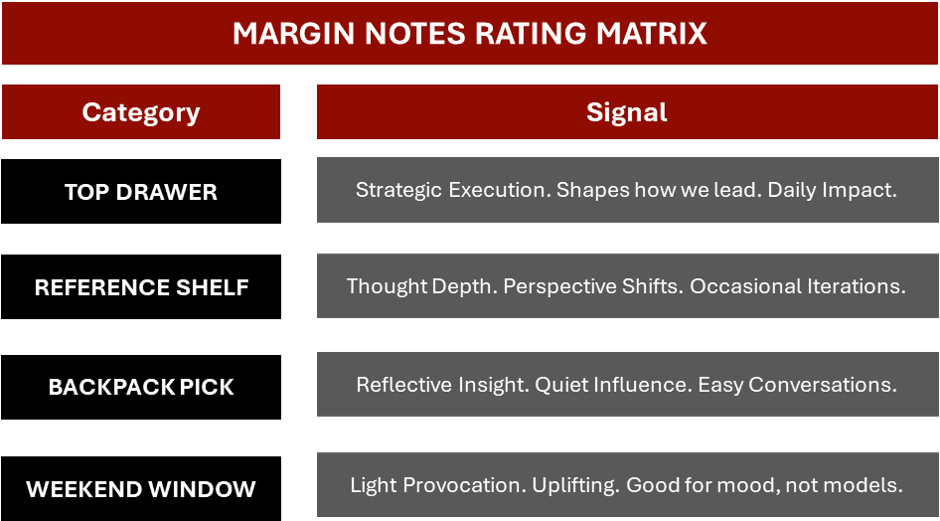
Margin Notes Rating Category: Reference Shelf
Leave a Reply