Category: Book Klub

  • Think Again: The Power of Knowing What You Don’t Know

    Think Again: The Power of Knowing What You Don’t Know

    Duration: 6 – 7 hours.

    Writing Style: Witty, fast-paced, with pop culture, business anecdotes and behavioural science references.


    What is the Main Hook of the Book ?

    The central hook is the underlying theme that intelligence is not the ability to think, it is the ability to rethink. He redefines success which is not about having all the answers but about having the humility to question what we think we know, the curiosity to explore alternatives, and the agility to change our minds without losing credibility.

    Standout feature: The chapter-end “Actions for Impact” toolkits that are quick guides that turn insights into habits for individuals, teams, and organisations.


    Premise / Core Idea

    The book is structured broadly across three themes:

    • Rethinking at the individual level
    • Encouraging others to rethink
    • Building cultures and systems of rethinking

    The book brings forth a lens on the following themes:

    Building Personas – The book is built around a core idea that cognitive flexibility – our ability to rethink, unlearn, and revise our opinions, is more critical to long-term success than knowledge or confidence. Grant outlines four mental personas that define how we engage with disagreement:

    • The Preacher – Tries to convince others of what they already believe
    • The Prosecutor – Tries to prove others wrong
    • The Politician – Tries to win favour and stay likeable
    • The Scientist – Seeks truth, revises beliefs based on evidence

    Think Again is a call to operate more like scientists allowing always questioning, always open, always iterating.

    Consultant Takeaway: Use the “Scientist Mindset” when engaging with client assumptions. Replace “This is the solution” with “Let’s test this hypothesis.” Clients respect confidence, but they trust curiosity and co-creation more.

    Power of Rethinking – Grant explores how subject-matter experts fall prey to overconfidence bias and confirmation bias. Rethinking isn’t natura, but it’s learnable. There is focus on the Dunning-Kruger Effect where he states that people with low ability overestimate themselves and how in contrary, the impostor syndrome, in moderation, can be healthy, it motivates humility and lifelong learning.

    Consultant Takeaway:

    • Building cognitive humility into the problem defining phases.
    • Using alternate scenario planning, and encouraging team members to play the role of  “devil’s advocate” roles early in strategy or transformation work.
    • Encourage teams to own both what they know and what they don’t.
    • Use “confidence intervals” in forecasts to express uncertainty honestly.

    The Joy of Being Wrong – People often fear being wrong because it threatens their identity. But rethinking can be joyful if we see it as learning, not losing.

    Consultant Takeaway:

    • Create space for clients to admit when legacy thinking no longer serves them.
    • Use “nonlinear learning” sessions in long-term projects to surface pivots or find new insights without judgment.

    The Good Fight Club – Constructive conflict (task conflict) strengthens teams when managed well. Grant distinguishes healthy disagreement from toxic arguments. Challenging each other makes teams smarter and work towards more productive outcomes.

    Consultant Takeaway: In cross-functional strategy work, establish ground rules for productive dissent. Use debate rituals (“one team argues for; one against”) to de-personalize disagreement and improve decisions

    Dancing with Foes – Grant encourages persuading sceptics or opponents with not with facts, but with curiosity, listening, and small concessions. He encourages asking questions that lead others to examine their own thinking.

    Consultant Takeaway:

    When facing resistance from client stakeholders (especially in transformation or change), shift the pattern of questioning to ask: “What would make this idea more workable for you?”

    Establishing Empathy – Grants suggests a more empathetic approach towards clients and other key stakeholders within or external to the organisation. Shared identity unlocks mutual understanding.

    Consultant Takeaway:

    In silos (e.g., finance vs. sales), frame problems as “our shared challenge,” not “their issue.” Use empathy-building exercises to soften resistance during operating model redesigns.

    Mild Mannerisms – In order to support change and promote growth, the book showcases how when persuading others, it’s better to start small and let them come to their own conclusions. The key is not present overwhelming evidence.

    Consultant Takeaway:

    • People don’t resist change; they resist being changed.
    • Use “laddering” in client presentations. Start with their pain points, validate them, and then introduce rethinking gradually.
    • Avoid information overload or lecturing.

    Art of Conversation – Think Again warrants the need for emotional listening and creating an ecosystem of and psychological safety because in the end, it’s not just facts that will change minds.. Emotion and effective listening, matter and hold equal ground.

    Consultant Takeaway:

    • When discussing risk, compliance, or culture gaps; listen more than you speak.
    • Say: “I hear you. What makes this issue important to you?”
    • Lead with trust before data.

    Rewriting the Source Code – Grant firmly establishes the concept of rethinking that needs to be  built into education and professional development. He emphasises the need to teach people how to think, not just what to think. Organizational rethinking requires systems and habits. Grant explores companies that build “challenge networks,” encourage dissent, and reward curiosity.

    Consultant Takeaway: Infuse consulting engagements with “learning loops.” Don’t just deliver a model, teach how to challenge it, adapt it, and sustain it.

    Escaping Tunnel Vision – Success can breed overconfidence. Even high-performers must question their assumptions.

    Consultant Takeaway:

    • In high-growth clients, beware of “success trap thinking.”
    • Encourage scenario reviews: What assumptions would kill this model if they changed tomorrow?

    Abandoning Best Practices – Best practices are often frozen thinking. The best leaders ask: What’s our “next practice”?

    Consultant Takeaway: While building the target operating model or revenue design work, challenge the best practices. Ask: “What worked last year and why might it fail next year?”


    Application

    As a young consulting firm, our credibility is built, not just on what we know, but on how we think. Think Again isn’t just relevant; it’s foundational to how we want to shape our work and our voice.

    Here’s where it intersects with our journey:

    • In Risk Advisory – The hardest part of risk management isn’t designing controls; it’s overcoming overconfidence and confirmation bias. Grant’s tools help us reframe risk culture not as a checklist but as a way of thinking. Example: In a risk audit for a mid-sized financial services client, we asked business heads to list what they feared most vs. what they thought would never happen. It became a mirror, 90% of their risk events had roots in the “never will happen” zone.
    • In Finance Transformation – Legacy assumptions drive process design, budgeting, and forecasting. Grant champions a concept called “pre-mortems” to challenge those assumptions and invite rethinking. Example: While reworking a client’s zero-based budgeting framework, we asked, “If you had to start this business unit today, would you structure it this way?” The result: two outdated cost centres merged into one agile shared service.
    • In Revenue Strategy – Rethinking helps us build smarter go-to-market plans. It helps us challenge “This is how we’ve always sold,” and shifts the conversation to “What if we were wrong about what the customer wants?” Example: One B2B firm had been investing heavily in demos and roadshows. Post-rethink, it was uncovered that most qualified leads were coming from technical webinars. That led to a revenue reallocation that increased marketing ROI by 40%.

    Challenger Thoughts

    • More depth on emotional triggers – While Grant talks a lot about cognitive habits, he underplays the emotional toll of changing long-held beliefs. More consideration on how does one manage status, vulnerability, or shame would be helpful.
    • There could be more frameworks that provide  guidance on how to build “rethinking” into recurring rituals such as boardrooms, investment committees, or cross-functional project teams.

    Conclusion

    Think Again isn’t a leadership book, a change book, or a productivity book, it’s a thinking book. It gives you the tools to unlearn, reframe, and become more agile, not in your actions, but in your beliefs.

    What resonated deeply with us was:

    • Good consultants don’t always have the best ideas, they ask the best questions. This book validates that and sharpens how we show up: not as Preachers with a fixed model, but as Scientists who learn through inquiry.
    • Disagreement isn’t dangerous; it’s the source code for better ideas.
    • Build curiosity and instead of disagreeing, try to understand what led them to that view. It creates psychological safety and better decision quality.

    Rethinking isn’t weakness. It’s wisdom. And for those of us building businesses, and shaping new models; it’s the most powerful skill we can cultivate.

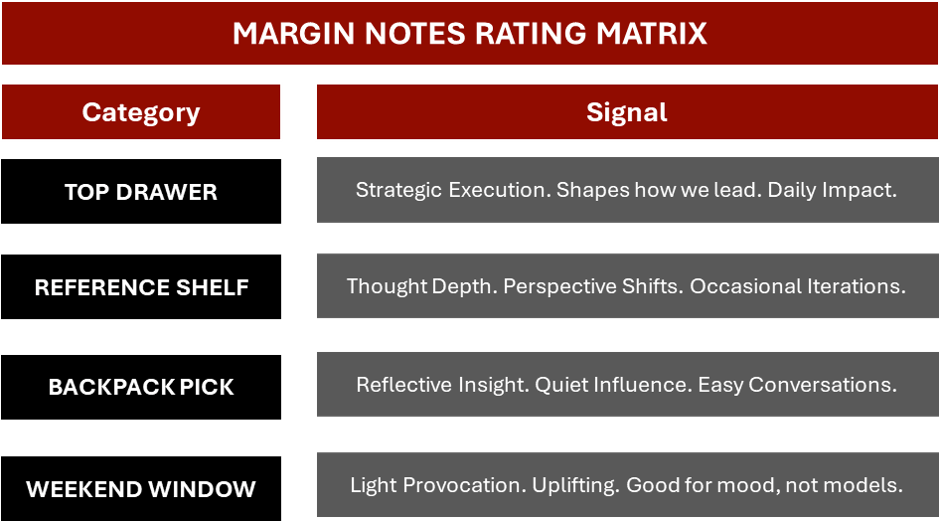
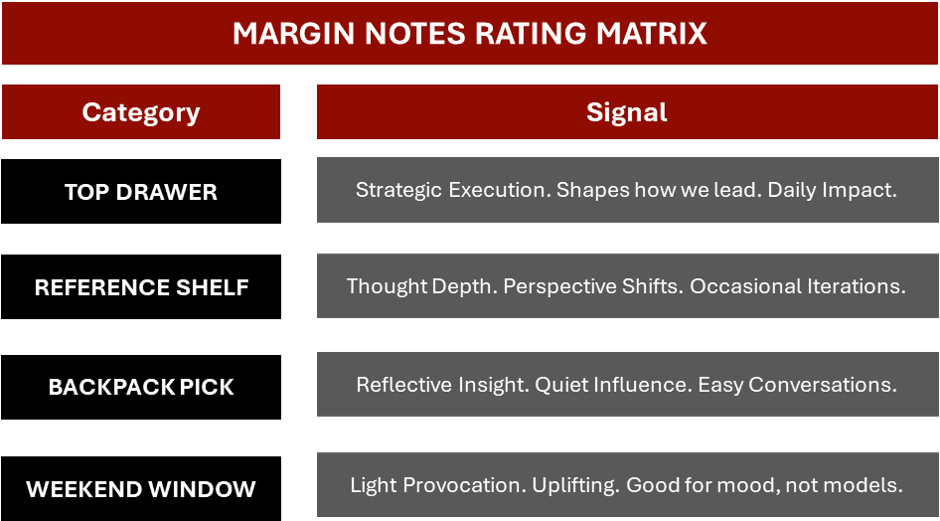
    Margin Notes Rating Category: Reference Shelf
  • Good to Great: Why Some Companies Make the Leap… and Others Don’t

    Good to Great: Why Some Companies Make the Leap… and Others Don’t

    Duration: 4-5 hours

    Writing Style: Collins blends rigorous research with engaging storytelling, using vivid metaphors and case studies to make complex concepts accessible.

    What is the Main Hook of This Book?

    The biggest hook of Good to Great is its data-driven dismantling of business myths. It doesn’t promise overnight success or unicorn formulas. Instead, it shows with humility and precision, how companies that were once merely good, evolved into great ones by embracing discipline, confronting reality, and building enduring systems.

    Premise / Core Idea

    At its core, Good to Great presents a compelling case: greatness is not a function of circumstance but of conscious choice and discipline. Through years of research and company comparisons, Collins and his team identify key concepts that repeatedly showed up in successful transitions:

    • Level 5 Leadership: A unique combination of personal humility and fierce professional will.
    • First Who, Then What: Get the right people on the bus, then figure out the direction.
    • Confront the Brutal Facts: Foster a culture where truth is welcomed, not feared.
    • The Hedgehog Concept: Find the intersection of what you can be best at, what drives your economic engine, and what you’re deeply passionate about.
    • The Flywheel Effect: Sustainable change comes from cumulative momentum, not flashy revolutions.
    • A Culture of Discipline: Disciplined people, disciplined thought, and disciplined action – all working within a clear framework.
    • Technology Accelerators: Great companies use technology strategically to enhance their Hedgehog Concept, not as a reactive fix. They pioneer applications that align with their core strategy.

    These concepts aren’t theoretical, they are actionable, and that’s what makes them transformative.

    Application: Where the Book Meets Our Journey

    Level 5 Leadership in Our Daily Work

    This idea strikes a deep chord. The humility to accept your mistakes, take feedback constructively and then quietly persist with the will to deliver results, felt like an ideal to strive for. This moves beyond personal achievement and focuses on how micro effort contributes to the success of the broader project and company. That mental shift not only improves outcomes, but also makes work more purposeful and aligned.

    “First Who, Then What”

    This concept reminds us of how all our core solutions were designed and developed. Identifying subject matter stalwarts with domain expertise, who worked alongside our consulting team laid the genesis of a strong team. The clarity of “putting the right people in the right seats” helps us achieve our goal with far more precision, depth and efficiency.  A strategic team building exercise is crucial for long term success, and Good to Great reaffirmed its long-term value.

    Confronting Brutal Facts in Real-Time Projects

    In the consulting world, we are most often doled out certain hard truths – things don’t work in the manner that we envisioned, timelines are in danger due to unexpected friction or our approach requires a different lens. This book inspires us to face these challenges head on and take immediate action to ensure that intended outcomes are not compromised and client satisfaction reigns supreme.

    The discipline of “autopsies without blame” and honest dialogue helps cultivate trust and agility – both of which are critical in the consulting world.

    The Hedgehog Concept – Strengths Over Weaknesses

    This concept is based on the central idea that encourages companies (and leaders) to achieve greatness by focusing on what they can do best – by simplifying a complex world into a single organising idea, much like a hedgehog defends itself with one powerful trick.

    Why it matters :

    • It brings clarity and discipline.
    • It allows companies to focus energy rather than spread it thin.
    • It provides a framework for strategic alignment across teams and functions.
    • It’s not a goal; it’s an understanding. And it evolves through insight, not planning.

    Culture of Discipline in My Current Role

    At Karmine, we are empowered with the freedom to ideate, express and take complete ownership, while operating within a framework that resides on clarity, consistency communication and effective control. This is in alignment with the fundamental principle of building a core discipline which the book lays emphasis upon. We encourage all tasks and activities to be governed by the above principles.

    Further, this encourages us to  imbibe “rinse the cottage cheese” – a metaphor that represents going the extra mile in pursuit of excellence, even in ways that seem small, unglamorous, or unnecessary to outsiders.  The focus is on three key elements:

    • Discipline in the Details: Great companies (and leaders) exhibit fanatical discipline not just in big strategies, but in small executional habits that compound over time.
    • Consistent Marginal Gains: Success is often built by stacking many small improvements that may seem trivial individually, but collectively make a significant difference
    • Culture of Excellence: The metaphor reinforces a mindset where every action is done with purpose, intentionality, and care, no matter how mundane it seems.

    Our Take

    Good to Great is one of those business books that carries the weight of data-backed frameworks, and yet leaves room for philosophical reflection.

    In contrast to other strategy texts that emphasise market opportunity or visionary thinking, this book roots greatness in unremarkable beginnings, steady leadership, the culture of discipline, and empirical creativity. Interestingly, the celebrated Level 5 Leader is almost anti-charismatic. He leads not by bold declarations, but through quiet resolve; a paradox many leadership theories overlook.

    We believe the strength of the book lies in operationalising what often feels intangible: greatness. Its principles are particularly useful in contexts of turnaround, scaling responsibly, or institutionalising excellence. However, it does little to account for volatile, rapidly changing environments where agility may trump discipline.

    What stood out to us:

    • Greatness is not a function of circumstance but of conscious choice.
    • The importance of talent before strategy.
    • Transformation is not an event, but the compounding of small wins.

    Its a book for those building endurance, not just speed. In a world obsessed with instant success, Good to Great is a refreshing reminder that lasting impact comes from deliberate, often invisible, consistency.

    Challenger Thoughts

    While the book is deeply insightful, there are areas where a more modern context or critical lens might help. For instance:

    • Level 5 Leadership, while inspiring, may seem difficult to sustain in startup or high-velocity environments where quick decision-making and bold presence are often rewarded more visibly than humility.
    • The book’s company examples (e.g., Circuit City, Fannie Mae) have aged poorly in some cases. It raises an important question: Can a company truly be called “great” if its success isn’t durable beyond a decade?
    • The data is U.S centric and may not reflect the diverse market dynamics and leadership cultures in countries like India or others in Asia.
    • The focus on internal discipline doesn’t always account for external disruptions like regulatory shocks, geopolitical events, or tech displacements that can radically impact a company’s trajectory, regardless of leadership intent.

    That said, these critiques don’t diminish the core value of the book. They simply invite a layer of critical application and adaptability.

    This book certainly earns a place in your “Top Drawer.” Its lessons on leadership, discipline, and strategic focus shape how we show up every day, guiding decisions with quiet but powerful influence.


    Article content
  • The Inner Game of Tennis

    The Inner Game of Tennis

    Curated fortnightly reads from Karmine book worms to set discerning minds into motion.

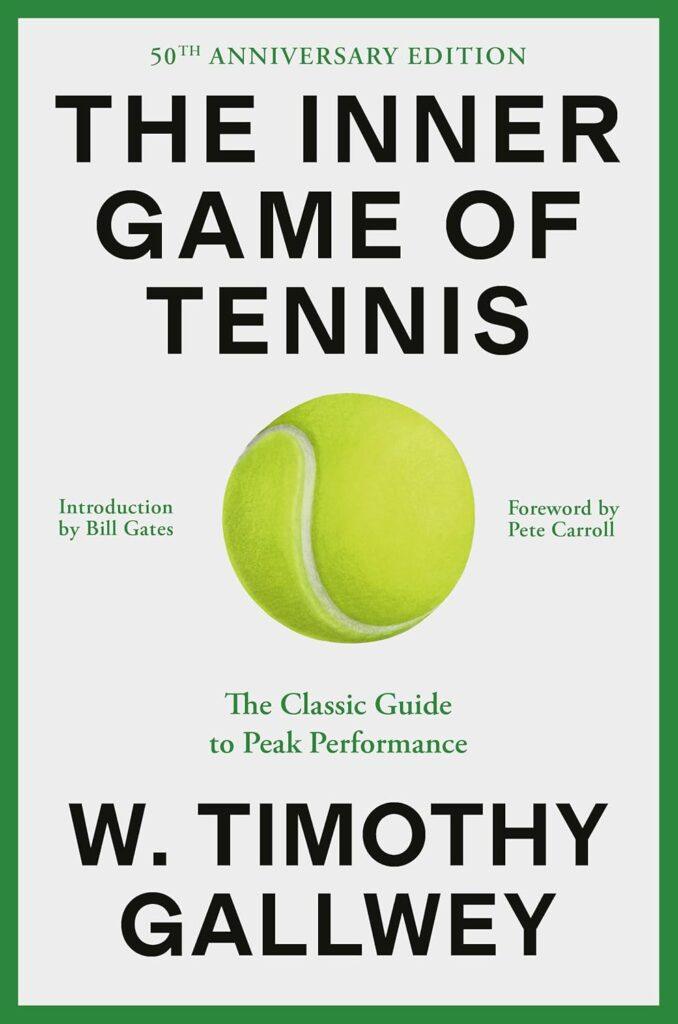
    Book Title: Inner Game of Tennis

    Author: W. Timothy Gallwey

    Duration: 2-4 hours

    Writing Style: Conversational & Reflective

    What is the main hook of this book?

    “The opponent within one’s own head is more formidable than the one across the net.”

    W. Timothy Gallwey wrote a book about tennis that somehow ended up on the shelves of CEOs, therapists, coaches, and just about anyone looking to master their mind. Some of the credit may belong to Bill Gates who couldn’t recommend this book enough. But it is eventually the sheer quality of the perspective that allowed these pages to be revisited by readers again and again.

    Because the real game Gallwey talks about is the one we play against ourselves. Let’s dive into what makes this classic worth returning to — even if you’ve never held a racquet.

    Premise / Core Idea

    Gallwey leverages the metaphor of tennis training to introduce a deceptively simple idea as his ‘core premise’. That we are not one, but two players:

    Self-1: The voice in our head. Critical, controlling, always nudging instructions.

    It’s the voice that judges, plans, worries, compares, and tries to “manage” performance. It thrives on the constant chatter – “Don’t miss,”

    “Why did you do that?”, “You’re messing up again.” In the author’s view, Self 1 doesn’t trust the body (Self 2) and constantly tries to override its natural instincts.

    At workplace, Self 1 often appears in the form of overthinking, micromanagement, perfectionism, and fear of failure.

    Self-2: The natural doer (the body). Instinctive, capable, quietly competent, if left alone.

    This is our intuitive, subconscious self, basically our body that quietly operates with literally no interference from us. The part that knows how to do things once it has learned. The body naturally learns best through awareness and experience, not commands.

    Classic example being, children learn to walk, catch, and run through leveraging Self 2 which is by observing, trying, and adjusting. Self-2 doesn’t talk or ruminate. It simply acts and most often, effortlessly.

    The inner game according to the author is about reducing the interference of Self 1 so Self 2 can do its thing. In practice, it is the difference between ‘thinking about the shot’ and ‘letting your body remember it.’ Self-2 the author maintains, knows how to swing once it’s seen and felt it. But Self-1 disrupts the flow by overanalyzing the motion mid-swing.

    And is it not just about tennis. That’s equally about presenting in a boardroom, pitching a client, even parenting a toddler at bedtime. It of course comes with continuous practice and preparing the Self-2 to naturally adapt to what it intuitively understands rather than the suggestive narrative which Self-1 provides.

    Trying Hard ≠ Performing Well

    One of Gallwey’s sharpest provocations is this: ‘Trying too hard is often the very thing that gets in the way.’

    In a world obsessed with hustle, this feels refreshingly subversive. He suggests that when we grip tighter, we lose fluidity. When we judge every move, we shrink our range. And when we over-correct, we forget how to just be.

    There’s liberation in realizing that peak performance isn’t about doing more, but interfering less. Formulaically speaking, it becomes thus – Performance = Potential – Interference.

    Observation Over Judgment

    This practice of non-judgmental observation is recommended to build awareness without anxiety. Applied off-court, it’s the kind of lens that helps leaders reflect without spiraling, coaches listen without fixing, and professionals learn without flinching.

    Application

    Let us try and apply some of these concepts in our business world. For example, how does this book link to risk management principles?

    Risk management, too, is often less about the risk itself and more about how organizations respond to it internally. Whether with clarity or chaos. The principles can reframe modern risk management.

    Self-1 over-instructs, micromanages and doubt. It is a control culture obsessed with rules, checklists, and optics.

    Self-2 acts with instinct, flow, and trust based on defined boundaries of principles. It is a culture that enables sound judgment, awareness, and empowered decisions.

    Another practical view point is the question we are always asked when we meet our clients – What are the new tools, layers, processes, technology levers that we can build into the system? How much do they cost? What are others in my peer group doing?

    Instead of layering with new information, the better questions to ask might be – What’s getting in the way of existing capability? Are we sufficiently leveraging what we already have? How can we optimize our existing tech stack to enable greater efficiencies?

    An underrated luxury we are all given is also to do with the innate body intelligence or what we often call, ‘intuition’. We select our favourite candidates in the first few minutes of the conversation, the VCs often make up their mind even before they know the numbers and one handshake is good enough to say no. Optimally leveraging the strength of Self-2 is sometimes they key difference between good and bad decisions.

    Our Take (~150–200 words)

    n many ways the concept is not necessarily new. A tangent of this is also dealt with in the seminal work – Thinking, fast & slow, buy Daniel Kahnemann where he talks about the dual nature but with a different lens (system 1 & 2 – the intuitive and the slow, deliberate).

    It is important to bring this up because the conclusions are somewhat different. Gallwey wants us to trust intuition and reduce mental noise to improve superlative performance. It is the mantra of flow. Kanhemann is however wary of intuition. He wants us to question it, be wary of the over confidence is sometimes nudges us towards.

    We think the principles of Inner Game of Tennis are best leveraged in activities that require performance, creative flow, presence and coaching. The principles might somewhat leave us deluded if we apply it to say, building robust strategy, hiring, risk management and judgement calls. Those are the spaces where we need a healthy mix of both, Self-1 & Self-2, to optimize results.

    One concept we particularly liked was that of the value of an ‘opponent’ or an ‘adversary’. The book redefines competition in a very interesting manner. We will let a quote do the talking:

    “Once one recognizes the value of having difficult obstacles to overcome, it is a simple matter to see the true benefit that can be gained from competitive sports.

    In tennis who is it that provides a person with the obstacles he needs in order to experience his highest limits? His opponent, of course! Then is your opponent a friend or an enemy? He is a friend to the extent that he does his best to make things difficult for you.

    Only by playing the role of your enemy does he become your true friend. Only by competing with you does he in fact cooperate! No one wants to stand around on the court waiting for the big wave.

    In this use of competition, it is the duty of your opponent to create the greatest possible difficulties for you, just as it is yours to try to create obstacles for him. Only by doing this do you give each other the opportunity to find out to what heights each can rise.”

    The book offers:

    • A fresh lens that confidence is often quiet trust in your own self.
    • A reminder to coach less and believe more in others and ourselves
    • A perspective to manage performance anxiety by getting out of your own way

    It is a manual for uncluttering the mental court.

    Challenger thoughts

    • Most Cognitive Behavioral Approach (CBTs) suggest we work with our inner dialogue, actively analyse their validity and reshape them instead of completely ignoring the noise. We think inner critic is not always noise. It is our in-house risk manager.
    • Another aspect that is somewhat overlooked in the book is the value of practice and consistent effort in the right manner. Entering in to confident flow does require immense ‘conscious’ practice. Trusting intuition before that may not be fruitful.
    • Self-1 and Self-2 might be an over-simplistic model? Perhaps our internal decision making is not all that straightforward and we are driven by things far more unknowable and uncontrollable.
    • Structure, systems and cadence are crucial to enabling successful utilization of Self-2.

    The Thinking Shelf™ Rating

    This book certainly hits your “Reference Shelf”. We may not open it often. But the insights remain ever more valuable to challenge our assumptions of peak performance.

    Choose one from the below with a short rationale:

    • Top Drawer (Strategic Execution)

    Shapes how we lead. High impact on daily decisions.

    • Reference Shelf (Thought Depth)

    Changes how we think at a macro level. Rarely opened, never forgotten.

    • Backpack Book (Reflective Insight)

    We take it on walks. Influences philosophy more than playbooks.

    • Weekend Window (Light Provocation)

    A light, inspiring read—good for mood, not models.

  • Inner Game of Tennis

    Inner Game of Tennis

    Duration: 2-4 hours

    Writing Style: Conversational & Reflective

    What is the main hook of this book?

    Gallwey wrote a book about tennis that transcended sport, landing on desks of CEOs, coaches, and therapists alike. Part of its cult status may stem from fans like Bill Gates, but its staying power lies in a deceptively simple idea: performance is an inner game – the one we play against ourselves.

    The opponent within one’s own head is more formidable than the one across the net.

    Premise / Core Idea

    Gallwey splits the self into two players:

    Self-1: The voice in our head. judgmental, anxious, controlling. In the author’s view, Self-1 doesn’t trust the Self- 2 and constantly tries to override its natural instincts.

    At workplace, Self-1 often appears in the form of overthinking, micromanagement, perfectionism, and fear of failure.

    Self-2: The natural, intuitive doer (the body). instinctive, capable, and fluid when left alone.

    This is our intuitive, subconscious self, the part that knows how to do things once it has learned. Classic example being, children learn to walk, catch, and run. Self-2 doesn’t talk or ruminate. It simply acts and most often, effortlessly.

    Peak performance, he argues, comes not from trying harder but from silencing Self-1 and trusting Self-2. The body knows what to do and thinking often gets in the way. This principle applies far beyond sport: whether in boardrooms, negotiations, or bedtime parenting routines.

    The inner game according to the author is about reducing the interference of Self 1 so Self 2 can do its thing. In practice, it is the difference between ‘thinking about the shot’ and ‘letting your body remember it.’ Self-2 the author maintains, knows how to swing once it’s seen and felt it. But Self-1 disrupts the flow by overanalyzing the motion mid-swing.

    Trying Hard ≠ Performing Well

    One of Gallwey’s sharpest provocations is this: ‘Trying too hard is often the very thing that gets in the way.’

    In a world obsessed with hustle, this feels refreshingly subversive. He suggests that when we grip tighter, we lose fluidity. There’s liberation in realizing that peak performance isn’t about doing more, but interfering less.

    Formulaically speaking, Performance = Potential – Interference. Observation over judgment is recommended. Instead of critiquing every move, simply notice. Leaders, coaches, and professionals can benefit from this lens thus fostering awareness without anxiety.

    Application

    The book’s principles align surprisingly well with modern business dynamics. Take risk management:

    · Self 1- driven cultures rely on control, checklists, and fear of failure.

    · Self 2- enabled cultures emphasize trust, intuition, and clarity within structured boundaries.

    Instead of endlessly adding tools, the smarter approach might be asking: What’s interfering with what we already have? In high-stakes environments, from VC funding calls to talent selection, gut instinct often leads the charge. Harnessing Self-2 effectively can be the difference between overthinking and insight.

    Our Take

    Gallwey’s core idea parallels Kahneman’s Thinking, Fast and Slow, yet reaches different conclusions. Kahneman warns us of intuition’s flaws. Gallwey wants us to lean into it, especially in performance-driven arenas.

    We think the principles of Inner Game of Tennis are best leveraged in activities that require performance, creative flow, presence and coaching. The principles might somewhat leave us deluded if we apply it to say, building robust strategy, hiring, risk management and judgement calls. Those are the spaces where we need a healthy mix of both, Self-1 & Self-2, to optimize results.

    One standout concept: Your opponent is your ally. The book redefines competition in a very interesting manner. We will let a quote do the talking:

    The book offers a manual for uncluttering the mental court, a fresh lens that confidence is often quiet trust and a toolbox to manage performance anxiety by quietening inner critic.

    Challenger thoughts

    • Most Cognitive Behavioral Approach (CBTs) suggest reshaping and not ignoring / silencing our inner dialogue. We think inner critic is not always noise. It is our in-house risk manager.
    • Gallwey perhaps underplays the role of structured, conscious practice. Intuition / flow needs training. Trusting intuition before that may not be fruitful.
    • The Self-1 vs Self-2 model might be too binary. Human behavior is more complex and layered.
    • Structure, systems and cadence are crucial to enabling successful utilization of Self-2.