Duration: 2-4 hours
Writing Style: Conversational & Reflective
What is the main hook of this book?
Gallwey wrote a book about tennis that transcended sport, landing on desks of CEOs, coaches, and therapists alike. Part of its cult status may stem from fans like Bill Gates, but its staying power lies in a deceptively simple idea: performance is an inner game – the one we play against ourselves.
The opponent within one’s own head is more formidable than the one across the net.
Premise / Core Idea
Gallwey splits the self into two players:
Self-1: The voice in our head. judgmental, anxious, controlling. In the author’s view, Self-1 doesn’t trust the Self- 2 and constantly tries to override its natural instincts.
At workplace, Self-1 often appears in the form of overthinking, micromanagement, perfectionism, and fear of failure.
Self-2: The natural, intuitive doer (the body). instinctive, capable, and fluid when left alone.
This is our intuitive, subconscious self, the part that knows how to do things once it has learned. Classic example being, children learn to walk, catch, and run. Self-2 doesn’t talk or ruminate. It simply acts and most often, effortlessly.
Peak performance, he argues, comes not from trying harder but from silencing Self-1 and trusting Self-2. The body knows what to do and thinking often gets in the way. This principle applies far beyond sport: whether in boardrooms, negotiations, or bedtime parenting routines.
The inner game according to the author is about reducing the interference of Self 1 so Self 2 can do its thing. In practice, it is the difference between ‘thinking about the shot’ and ‘letting your body remember it.’ Self-2 the author maintains, knows how to swing once it’s seen and felt it. But Self-1 disrupts the flow by overanalyzing the motion mid-swing.
Trying Hard ≠ Performing Well
One of Gallwey’s sharpest provocations is this: ‘Trying too hard is often the very thing that gets in the way.’
In a world obsessed with hustle, this feels refreshingly subversive. He suggests that when we grip tighter, we lose fluidity. There’s liberation in realizing that peak performance isn’t about doing more, but interfering less.
Formulaically speaking, Performance = Potential – Interference. Observation over judgment is recommended. Instead of critiquing every move, simply notice. Leaders, coaches, and professionals can benefit from this lens thus fostering awareness without anxiety.
Application
The book’s principles align surprisingly well with modern business dynamics. Take risk management:
· Self 1- driven cultures rely on control, checklists, and fear of failure.
· Self 2- enabled cultures emphasize trust, intuition, and clarity within structured boundaries.
Instead of endlessly adding tools, the smarter approach might be asking: What’s interfering with what we already have? In high-stakes environments, from VC funding calls to talent selection, gut instinct often leads the charge. Harnessing Self-2 effectively can be the difference between overthinking and insight.
Our Take
Gallwey’s core idea parallels Kahneman’s Thinking, Fast and Slow, yet reaches different conclusions. Kahneman warns us of intuition’s flaws. Gallwey wants us to lean into it, especially in performance-driven arenas.
We think the principles of Inner Game of Tennis are best leveraged in activities that require performance, creative flow, presence and coaching. The principles might somewhat leave us deluded if we apply it to say, building robust strategy, hiring, risk management and judgement calls. Those are the spaces where we need a healthy mix of both, Self-1 & Self-2, to optimize results.
One standout concept: Your opponent is your ally. The book redefines competition in a very interesting manner. We will let a quote do the talking:
“… In tennis who is it that provides a person with the obstacles he needs in order to experience his highest limits? His opponent, of course! Then is your opponent a friend or an enemy? He is a friend to the extent that he does his best to make things difficult for you.”
“…Only by playing the role of your enemy does he become your true friend. It is the duty of your opponent to create the greatest possible difficulties for you, just as it is yours to try to create obstacles for him. Only by doing this do you give each other the opportunity to find out to what heights each can rise…”
The book offers a manual for uncluttering the mental court, a fresh lens that confidence is often quiet trust and a toolbox to manage performance anxiety by quietening inner critic.
Challenger thoughts
- Most Cognitive Behavioral Approach (CBTs) suggest reshaping and not ignoring / silencing our inner dialogue. We think inner critic is not always noise. It is our in-house risk manager.
- Gallwey perhaps underplays the role of structured, conscious practice. Intuition / flow needs training. Trusting intuition before that may not be fruitful.
- The Self-1 vs Self-2 model might be too binary. Human behavior is more complex and layered.
- Structure, systems and cadence are crucial to enabling successful utilization of Self-2.
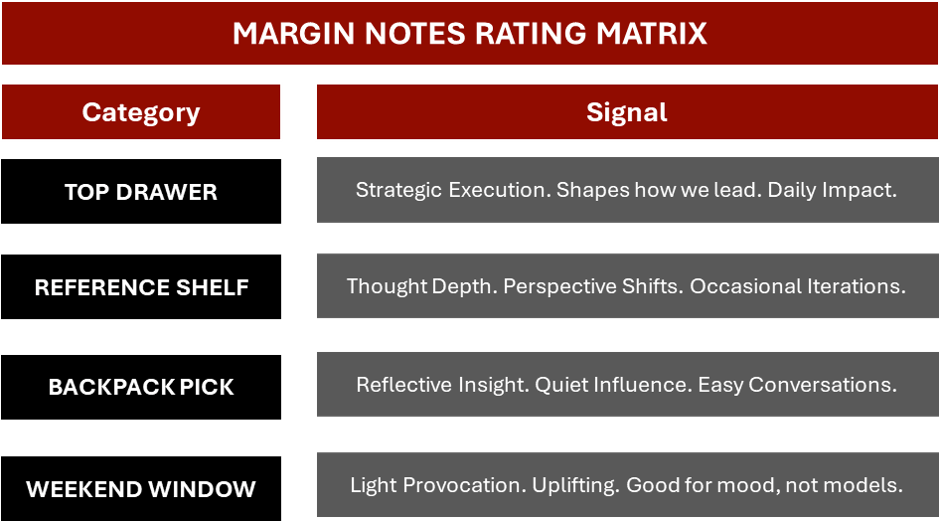
Margin Notes Rating Category: Reference Shelf
Leave a Reply